

The Underwater: National Academy of Sciences Solo Exhibition. Washington, D.C.
July 2024
What can Nature-based Solutions and sustainability professionals learn from cultural institutions such as museums and botanical gardens? How can the synergies benefit both NbS and cultural institutions?
The Nature of Cities Global Roundtable
By Xavier Cortada
December 9, 2024
Throughout history, art has served as a universal language, handed down from our ancestors. It transcends time, culture, and geography, offering us the tools to connect, inspire, and communicate with one another in ways that words alone cannot. Today, as we face unprecedented environmental challenges, this ancient power of art can help us rediscover something deeply ingrained within us—our connection to nature. Nature-based solutions (NbS) are not foreign concepts to humanity. They are inherent within us because we are part of nature itself. Yet, over centuries, we have become increasingly disconnected from this understanding. Art can be the bridge that helps us reconnect with both each other and the natural world, fostering a deeper awareness of our shared humanity and the urgent need for change.
In this moment of ecological crisis, it is clear that we cannot continue to engineer solutions that work in opposition to nature. As I wrote in “A 20-Foot Sea Wall is Not the Answer,1” the idea of building ever higher walls to protect against rising seas is emblematic of our misguided attempts to control and resist nature. Instead, we must move toward solutions that work in harmony with the natural world, and art can be instrumental in this shift. Art, as I have explored in “Reclaiming Art2” allows us to see the world differently, to question our assumptions, and to imagine new possibilities. It opens up creative ways of thinking and being, which are essential if humanity is to survive and thrive in the face of climate catastrophe. We need to press reset, to reconsider how we live, how we relate to the Earth, and how we can co-create a more sustainable future.
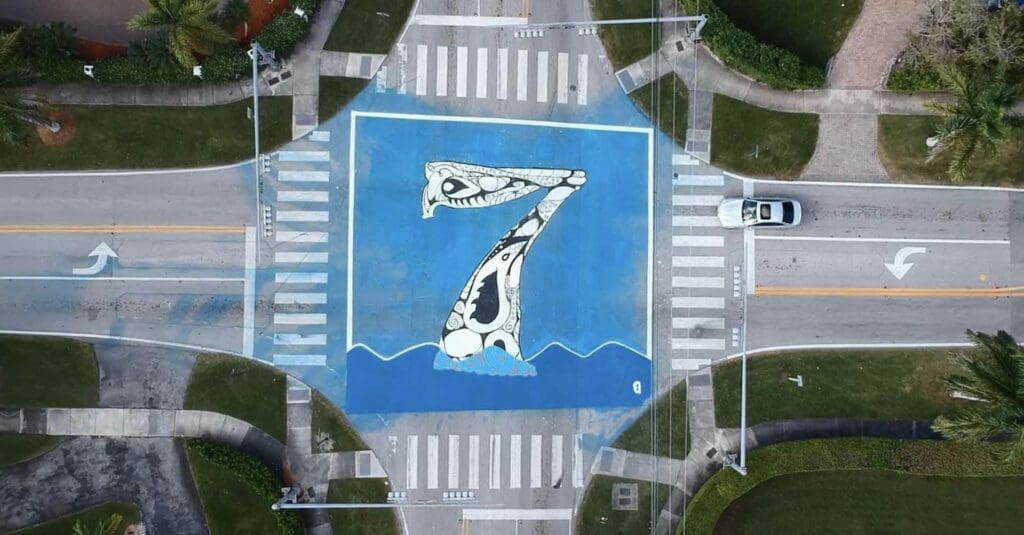
Underwater HOA Elevation Drive: 7 feet Pinecrest, FL. December 2018

Underwater HOA Elevation Yard Sign: 8 feet Artist’s Studio Pinecrest Gardens, FL. November 2018
This is where cultural institutions such as museums and botanical gardens come into play. They serve as gathering places where art, science, and community intersect. By collaborating with Nature-based Solutions professionals, these institutions can help us collectively reimagine our relationship with the planet. In my Underwater Homeowners Association project3, I saw firsthand how the integration of art and environmental science can mobilize communities. The project used elevation data and art installations to engage Miami residents in discussions about sea level rise and climate adaptation. The act of creating something visual and participatory sparked not just awareness, but action—neighbors came together to problem-solve and advocate for change. It demonstrated the power of art to turn abstract concepts into tangible realities that people can engage with on a personal level.
Cultural institutions, with their established roles in education and outreach, are uniquely positioned to amplify the impact of NbS by bringing these kinds of interdisciplinary approaches to the forefront. As I argued in “The Underwater: Using Art to Engage Communities Around Climate Action4” art’s ability to engage diverse audiences is crucial for addressing complex environmental issues. By weaving together scientific knowledge and cultural heritage, museums and botanical gardens can help NbS professionals create spaces where communities not only learn about climate change but also feel empowered to act. This collaboration has the potential to shift the public’s perception of environmental challenges from distant threats to immediate, actionable concerns.

The Underwater: Broward County
Underwater Bus Ft. Lauderdale, FL. March 2024

The Underwater: Miami-Dade Parks Sculpture Dedication at Demps Park
At the same time, these institutions stand to benefit from such partnerships. By incorporating NbS into their programming, museums and gardens can make themselves more relevant to contemporary issues, expanding their reach and deepening their impact. As I noted in “When it comes to climate, are cultural organizations breaking or losing ground?,5” art institutions are not just about preserving the past—they are vital platforms for dialogue, creativity, and innovation. The integration of NbS offers them fresh content and opportunities to engage with new, diverse audiences, particularly those who may not traditionally see themselves as part of the environmental movement.
In essence, the partnership between cultural institutions and Nature-based Solutions professionals represents a powerful synergy—one that not only helps us reconnect with the natural world but also challenges us to rethink how we engage with one another. Through this collaboration, we can build a more sustainable and inclusive future, rooted in creativity, connection, and a deep respect for the Earth.
1 “A 20-Foot Sea Wall is Not the Answer,” by Xavier Cortada, Biscayne Times, July 2021. See https://cortada.com/press/2021-press/a-20-foot-sea-wall-is-not-the-answer/
2 “Reclaiming Art.” By Xavier Cortada Posted in ARTSblog on November 9, 2011. See https://cortada.com/artist/writings/reclaiming-art/
3 See www.cortadafoundation.org/underwater
4 “The Underwater: Using Art to Engage Communities Around Climate Action,” 78 U. Mia, Rev. 519. Xavier Cortada (2024)
See https://repository.law.miami.edu/umlr/vol78/iss2/8
5 “When it comes to climate, are cultural organizations breaking or losing ground?,” by Xavier Cortada, American for the Arts / ArtsLink, Fall/Winter 2022.
See https://cortada.com/wp-content/uploads/2022/12/ArtsLink_Fall_Winter_2022_XavierCortada.pdf